Funnel.io Alternatives: Affordable Marketing Data Tools (2026)
Funnel.io too expensive? Compare 7 affordable alternatives for marketing data integration, with pricing and feature breakdowns for SMBs.
MetricNexus Team

Funnel.io is a powerful marketing data platform, but with pricing starting at $400+/month, it's built for enterprise marketing teams. If you're a small business or agency looking for similar functionality without the enterprise price tag, you have legitimate options.
The good news: you don't need to pay enterprise prices to solve the core problem Funnel.io addresses—bringing scattered marketing data into one place. The better news: the alternatives have gotten much more sophisticated in the past two years, with some offering specialized capabilities that Funnel.io doesn't match.
This guide compares seven alternatives across pricing, features, and use cases so you can find the right fit for your budget and team.
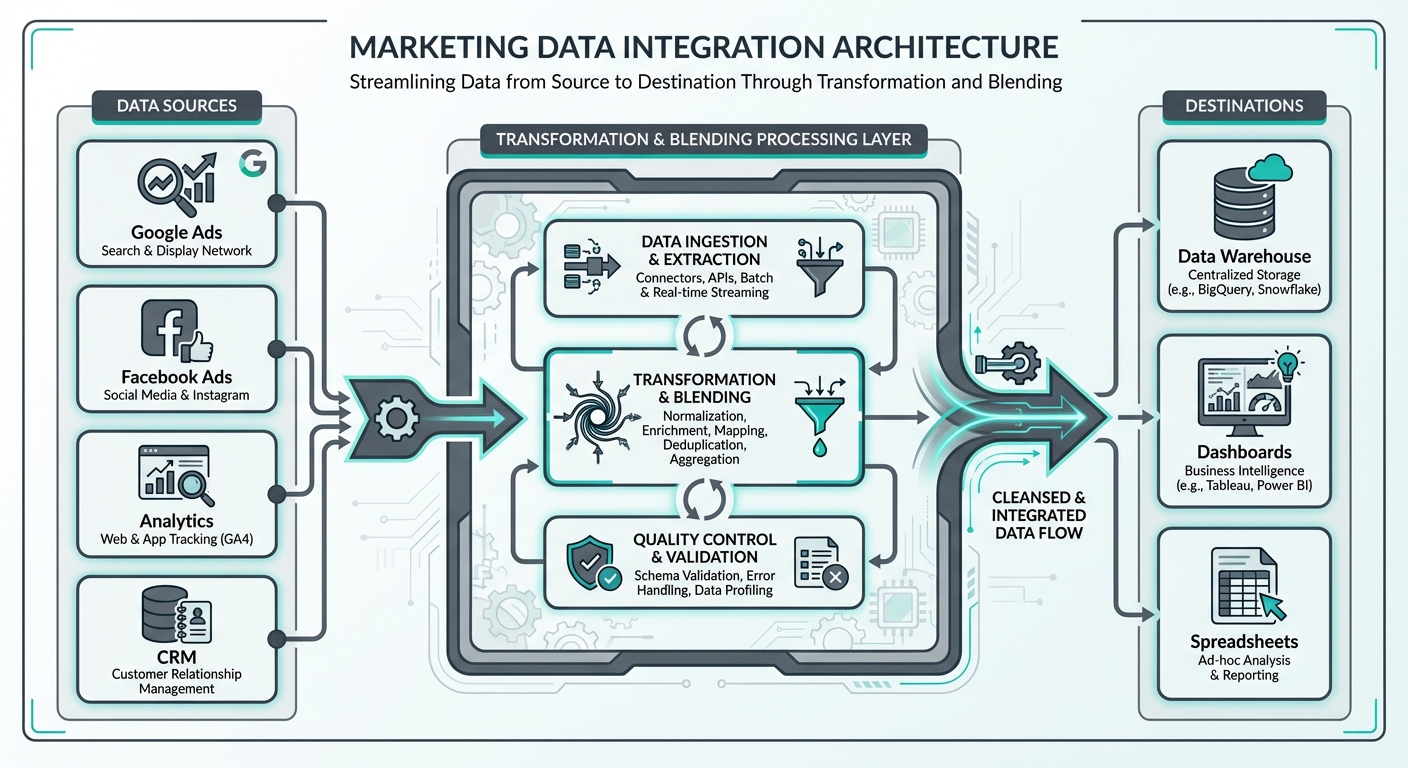 Marketing data integration architecture showing sources flowing through transformation to destinations
Why Funnel.io is Expensive (And Whether It's Worth It)
To understand why Funnel.io costs so much, it's worth understanding what you're paying for.
Funnel.io specializes in data transformation and governance. They don't just pull data from your marketing channels (Google Ads, Meta, etc.) and dump it somewhere—they normalize it, handle field mapping, resolve naming inconsistencies, and create a unified data model. Their platform includes:
- Advanced data transformation: Custom formulas, field calculations, and automated cleanup
- Historical data backfill: If you switch to Funnel.io, they'll backfill 2+ years of historical data
- Enterprise data governance: Strict role-based access control, audit logs, data residency options
- Dedicated support: Most plans come with dedicated success managers
- White-label options: Agencies can rebrand the platform
For enterprise marketing teams running 20+ campaigns across multiple channels with complex organizational structures, this is genuinely valuable. Funnel.io's data transformation layer alone can save agencies dozens of hours per month managing data consistency across clients.
But here's the reality for most small businesses and growing agencies: you're paying for features you'll never use. A 5-person agency doesn't need white-label infrastructure. A solo freelancer doesn't need an audit trail. And if you're willing to do a bit of manual field mapping in Excel or Google Sheets, you can save $400+/month.
The enterprise "Intelligence" tier costs $1,000+/month and adds AI-powered insights, custom dashboards, and priority support. At that price point, you should be using a data warehouse (like Snowflake or BigQuery) with a BI tool like Looker or Tableau instead.
Watch out for flexpoints: Funnel.io uses a credit-based pricing model called "flexpoints." Every connector, transformation, and export consumes flexpoints, and they run out faster than you'd expect. Users frequently report that their actual costs end up 2-3x higher than the base plan price once they start connecting real data sources. Some alternatives (like Coupler.io and MetricNexus) use flat-rate pricing specifically to avoid this surprise.
The Real Cost of Manual Marketing Data Management
Before diving into alternatives, it's worth understanding what you're optimizing for. According to industry research, companies spend 70% of their analytics time on data cleansing rather than actual analysis. Marketing teams using modern data integration tools report saving 70-100 hours per month on data preparation and reducing reporting time by up to 75%.
The question isn't just "how much does the tool cost?" but "how much time and money are you losing without one?" A $50/month tool that saves 20 hours of manual work pays for itself many times over.
Quick Comparison: Funnel.io Alternatives
Here's how seven alternatives stack up:
| Tool | Starting Price | Best For | Key Strength |
|---|---|---|---|
| MetricNexus | $49/month | SMBs needing AI-powered analytics | Conversational data queries, quick setup |
| Supermetrics | $29/month | Teams using Google Sheets/Looker | Largest connector library, proven reliability |
| Windsor.ai | $19/month | Budget-conscious teams | Affordable attribution modeling |
| Coupler.io | Free | Google Sheets-first workflows | Spreadsheet integration, free tier |
| Stitch Data | $100/month | Teams with data engineering resources | Open source option, warehouse-focused |
| Adverity | $500+/month | Enterprise needing Funnel.io alternative | Similar data governance capabilities |
| Improvado | $400+/month | Agencies wanting white-label platform | Agency-first approach, extensive connectors |
1. MetricNexus: AI-Native Marketing Analytics ($49-99/month)
MetricNexus is built specifically for small businesses and agencies that want sophisticated marketing analytics without hiring a data analyst.
How it compares to Funnel.io:
MetricNexus uses AI to handle the data transformation problem differently. Instead of requiring you to set up complex field mappings and custom formulas, you ask natural language questions about your marketing data. "Which campaigns drove the most revenue last month?" "What's our cost per conversion by channel?" The AI understands your data structure and returns insights without manual configuration.
What MetricNexus does better:
- Faster onboarding: 15 minutes to connect your channels and start querying data (vs. hours of configuration with Funnel.io)
- Natural language interface: Ask questions in plain English; the system translates to SQL
- Lower barrier to insight: No technical knowledge required; perfect for solo operators
- SMB pricing: $49-99/month scales with your usage
What Funnel.io does better:
- Data transformation: Funnel.io's field mapping and custom formulas are more flexible
- Historical backfill: Funnel.io will automatically backfill your entire history; MetricNexus requires ongoing data collection
- Custom dashboards: Funnel.io's visual dashboard builder is more polished than MetricNexus's text-first approach
- White-label options: If you're an agency, Funnel.io can be rebranded as your platform
Pricing: $49/month (Base) or $99/month (Pro) for additional data sources and priority support. No setup fees, no per-connector costs.
Best for: Freelancers, small marketing teams, and agencies that want to spend less time managing data tools and more time on strategy.
Typical setup: Connect Google Ads, Meta, and your CRM. Start asking questions immediately. No SQL required.
2. Supermetrics: The Industry Standard ($29-239/month)
Supermetrics is the Swiss Army knife of marketing data connectors. They've been in business since 2012 and probably connect to more marketing platforms than any competitor.
How it compares to Funnel.io:
Supermetrics is fundamentally a connector library, not a data transformation platform. You pick which channels to pull from (Google Analytics, Meta, LinkedIn, Microsoft Ads, TikTok, Shopify, etc.), choose your destination (Google Sheets, Looker Studio, BigQuery, Tableau), and Supermetrics handles the data pipeline. It's more of a "pick and place" tool.
What Supermetrics does better:
- Connector breadth: 120+ integrated platforms vs. Funnel.io's ~50
- Google Sheets integration: Unmatched if you live in Sheets; built-in formulas and functions
- Looker Studio native: Direct integrations; easier dashboard building
- Proven reliability: 13-year track record with major enterprises
- Custom API connectors: You can build your own integrations via API
What Funnel.io does better:
- Data transformation: Supermetrics pulls raw data; you manage the cleanup
- Unified reporting: Funnel.io standardizes data across channels; Supermetrics expects you to do this
- Automatic reconciliation: Funnel.io resolves multi-channel attribution automatically
Pricing structure:
- Lite: $29/month (1 data source, 10 reports)
- Standard: $79/month (5 sources, 100 reports)
- Professional: $239/month (unlimited sources, unlimited reports, priority support)
- Enterprise custom pricing available
Best for: Google Sheets power users, Looker Studio dashboard builders, and teams that prefer a lightweight connector over a heavy platform.
Typical setup: Create a Google Sheet, add Supermetrics functions to pull data from your channels, build charts in Sheets or Looker Studio.
3. Windsor.ai: Budget Attribution Tool ($19-149/month)
Windsor.ai is the scrappy startup approach to marketing data integration. They focus on what matters most to performance marketers: attribution and cost-per-result tracking.
How it compares to Funnel.io:
Windsor is laser-focused on a specific problem: connecting ad spend across channels to actual conversions. They're not trying to be a data warehouse; they're trying to answer one question well: "Which channels and campaigns drive ROI?"
What Windsor.ai does better:
- Attribution modeling: Multi-touch attribution without the complexity of Funnel.io
- Price: $19/month starter plan is genuinely affordable
- Ease of use: Minimal setup required; dashboard works out of the box
- Conversion tracking: Built-in conversion tracking across channels
What Funnel.io does better:
- Breadth of connectors: Windsor supports ~40 platforms vs. Funnel's 50+
- Custom reporting: Funnel.io's report builder is more flexible
- Data transformation: Funnel.io's field mapping capabilities are more advanced
- Enterprise features: Security, compliance, and white-label options
Pricing structure:
- Starter: $19/month (3 ad accounts, 1 conversion source)
- Growth: $59/month (10 ad accounts, 3 conversion sources)
- Scale: $149/month (unlimited accounts, 5 conversion sources)
Best for: E-commerce sellers, performance marketers, and agencies focused on proving ROI rather than complex data manipulation.
Typical setup: Connect your ad accounts and conversion tracking, view ROI dashboard. No data warehouse required.
4. Coupler.io: Spreadsheet-First Integration (Free - $250/month)
Coupler.io takes the opposite approach from Funnel.io. Instead of building a centralized data platform, Coupler.io brings all your data into Google Sheets or Excel where you're already working.
How it compares to Funnel.io:
If Funnel.io is "build a data warehouse," Coupler.io is "use what you already have." There's no separate dashboard, no additional tool to learn. Your data appears in Google Sheets on a schedule you set, and you build reports using Sheets formulas and charts.
What Coupler.io does better:
- Cost: Free tier handles basic integration needs
- Simplicity: One-click setup; data appears in Sheets
- Data ownership: Everything stays in your Google Drive
- Familiar interface: No new tool to learn; just Sheets
What Funnel.io does better:
- Data transformation: Funnel.io's transformation layer makes complex data manipulation easier
- Dashboard polishing: Funnel.io dashboards look more professional
- Scalability: Coupler.io has limitations on sync frequency and data volume at lower tiers
- Multi-user collaboration: Funnel.io's permission model is more sophisticated
Pricing structure:
- Free: 5 automations, 2-hour sync frequency
- Starter: $29/month (100 automations, 30-min sync)
- Professional: $99/month (unlimited automations, 10-min sync)
- Business: $250/month (priority support, SLA guarantees)
Best for: Small businesses already invested in Google Sheets, teams that want minimal tool switching, and budget-conscious operators.
Typical setup: Connect data sources in Coupler.io, specify which data goes to which Sheets, let it auto-sync. Build reports in Sheets.
5. Stitch Data: Warehouse-Focused Pipeline ($100-900+/month)
Stitch Data (owned by Talend) takes the "data warehouse first" approach. They're building a pipeline that moves data into your data warehouse (Snowflake, BigQuery, Redshift), and you use BI tools on top.
How it compares to Funnel.io:
Stitch is for teams ready to graduate beyond standalone tools. Instead of creating dashboards in Funnel.io, you'd create them in Looker, Tableau, or Power BI on top of your Stitch-managed data warehouse. This is more powerful but requires technical knowledge.
What Stitch Data does better:
- Open source option: Stitch Singer is free and open source
- Warehouse flexibility: Works with Snowflake, BigQuery, Redshift, PostgreSQL
- Scale: Built for massive data volumes
- Integration with BI tools: Better handoff to Looker/Tableau/Power BI
What Funnel.io does better:
- Ease of use: Stitch requires technical setup; Funnel.io is more self-service
- Pre-built dashboards: Funnel.io has templates; Stitch expects you to build dashboards
- All-in-one: Funnel.io is a complete platform; Stitch is a pipeline component
- Support: Funnel.io has dedicated support; Stitch is more community-driven
Pricing structure:
- Singer Open Source: Free (requires self-hosting and technical management)
- Managed Stitch: $100-900+/month depending on rows synced
Best for: Teams with data engineering resources, companies using Snowflake or BigQuery, and organizations that want maximum flexibility.
Typical setup: Set up Stitch to pull data into your data warehouse, write SQL queries or connect a BI tool, build dashboards.
6. Adverity: Enterprise Alternative to Funnel.io ($500+/month)
Adverity is positioned as a direct competitor to Funnel.io in the enterprise marketing data space. They offer similar capabilities: data integration, transformation, and governance.
How it compares to Funnel.io:
Adverity and Funnel.io are in the same category. Both are enterprise-grade platforms with sophisticated data transformation, both cost $500+/month, and both target mid-market and enterprise marketing teams. If you're considering paying enterprise prices, Adverity is worth evaluating alongside Funnel.io.
Key differences from Funnel.io:
- Slightly better attribution: Adverity's attribution modeling is considered slightly more sophisticated
- More expensive: Enterprise plans often run higher than Funnel.io
- Better for agencies: Agency-specific workflows and white-label options
- Steeper learning curve: More complex than Funnel.io in some areas
Pricing: Custom enterprise pricing, typically $500-1,500+/month depending on data volume and features.
Best for: Enterprise marketing teams comparing Funnel.io alternatives, large agencies needing white-label attribution.
The verdict: If you're evaluating Adverity, you probably have a budget for Funnel.io. Compare the two directly; the choice depends on your specific workflow and team preference.
7. Improvado: Agency-Focused Platform ($400+/month)
Improvado is built specifically for marketing agencies. They provide white-label data integration and analytics dashboards that agencies can offer to clients.
How it compares to Funnel.io:
Improvado is agency-first, while Funnel.io is enterprise-first (but used by many agencies). Improvado's entire business model is: "We'll handle your clients' data integration, and you brand it as your own service."
Key differences from Funnel.io:
- White-label out of the box: Designed for agency resale
- Client management: Built-in tools for managing multiple client data
- Connector breadth: 300+ connectors (more than Funnel.io)
- Similar pricing: $400+ per month, similar to Funnel.io's base tier
Best for: Agencies that want to offer data analytics as a service to clients without building the infrastructure themselves.
The verdict: Not an affordable alternative (Improvado costs as much as Funnel.io), but worth mentioning if you're an agency needing white-label infrastructure.
Feature Comparison: What You're Giving Up
If you leave Funnel.io for an affordable alternative, here's what you might lose and whether it matters:
| Feature | Funnel.io | MetricNexus | Supermetrics | Windsor.ai | Coupler.io | Impact |
|---|---|---|---|---|---|---|
| Data Transformation | Excellent | Good (AI-driven) | Limited | Basic | Minimal | High |
| Automatic Field Mapping | Yes | Partial | No | No | No | Medium |
| Historical Backfill | Up to 2 years | Requires ongoing collection | Custom limits | 6-12 months | Custom | Medium |
| Custom Dashboards | Highly polished | Text-based | Via Sheets/Looker Studio | Pre-built | Sheets-based | Low-Medium |
| Connectors | 50+ | 30+ | 120+ | 40+ | 80+ | Low |
| Multi-user Permissions | Advanced RBAC | Basic | Basic | Basic | Google Drive-based | Low |
| Enterprise Security | Advanced | Standard | Standard | Standard | Standard | High (enterprise only) |
| White-label | Yes | No | No | No | No | Agency-specific |
| Dedicated Support | Yes (all tiers) | Email/chat | Medium | |||
| API Access | Yes | Planned | Yes | Yes | Yes | Low |
User Satisfaction Ratings
Real user feedback matters when choosing a tool you'll use daily. Here's how these platforms rate on major review sites:
| Tool | G2 Rating | Capterra Rating | Key User Feedback |
|---|---|---|---|
| Funnel.io | 4.5/5 | 4.7/5 | Powerful but complex; steep learning curve |
| MetricNexus | 4.8/5 | 4.9/5 | Easy setup; AI queries are genuinely useful |
| Supermetrics | 4.4/5 | 4.5/5 | Reliable connectors; support quality varies |
| Windsor.ai | 4.8/5 | 4.7/5 | Affordable; attribution modeling is solid |
| Coupler.io | 4.9/5 | 4.9/5 | Dead simple; perfect for Sheets users |
| Stitch Data | 4.3/5 | 4.2/5 | Technical but flexible; requires SQL knowledge |
| Adverity | 4.4/5 | 4.5/5 | Enterprise-grade; expensive for what you get |
| Improvado | 4.5/5 | 4.6/5 | Good for agencies; onboarding takes time |
Note: Ratings as of early 2026. Funnel.io notably has a lower TrustPilot rating (2.4/5), with users citing unpredictable pricing and complexity as pain points.
The honest assessment:
Most small businesses won't notice the loss of data transformation. Funnel.io's advanced field mapping and automatic cleanup is genuinely impressive, but it requires complex marketing data to justify the complexity. If you're running straightforward campaigns in 2-3 channels, you can manually clean up data in a spreadsheet in 30 minutes.
The biggest loss is usually historical backfill. If you've been running campaigns for 2+ years and want to analyze trends, you'll need to deal with missing historical data. MetricNexus and Supermetrics can backfill selectively, but alternatives won't have years of historical context automatically.
Everything else—dashboards, connectors, support—has reasonable alternatives in the categories below.
Pricing Breakdown: Year-to-Year Comparison
Here's what you'd actually pay over a year with each tool:
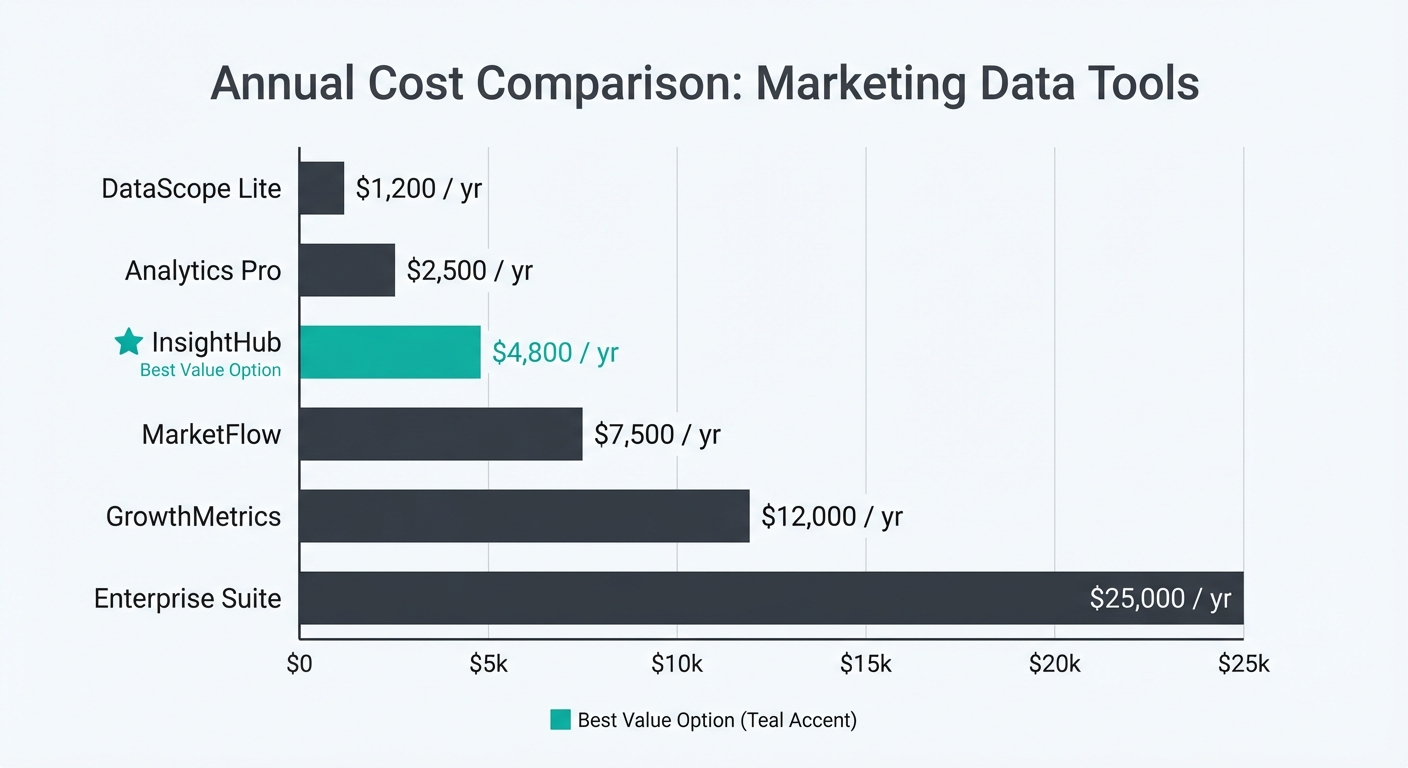 Annual cost comparison of marketing data tools
| Tool | Monthly Plan | Annual Cost | Typical Setup Cost |
|---|---|---|---|
| Funnel.io | $400-1,000+ | $4,800-12,000+ | Included |
| MetricNexus | $49-99 | $588-1,188 | Included |
| Supermetrics | $29-239 | $348-2,868 | Free |
| Windsor.ai | $19-149 | $228-1,788 | Free |
| Coupler.io | Free-250 | $0-3,000 | Free |
| Stitch Data | $100-900 | $1,200-10,800 | Free |
| Adverity | $500+ | $6,000+ | Setup included |
| Improvado | $400+ | $4,800+ | Setup included |
The math for a typical SMB:
- Using Funnel.io: $4,800-6,000/year
- Using MetricNexus: $600-1,200/year (75% savings)
- Using Supermetrics + Sheets: $348/year (93% savings)
- Using Windsor.ai: $228/year (95% savings, but limited scope)
For a 5-person team, switching from Funnel.io to MetricNexus saves $4,000-5,000/year. That's a full-time hire's salary savings.
Decision Framework: Which Alternative Is Right For You?
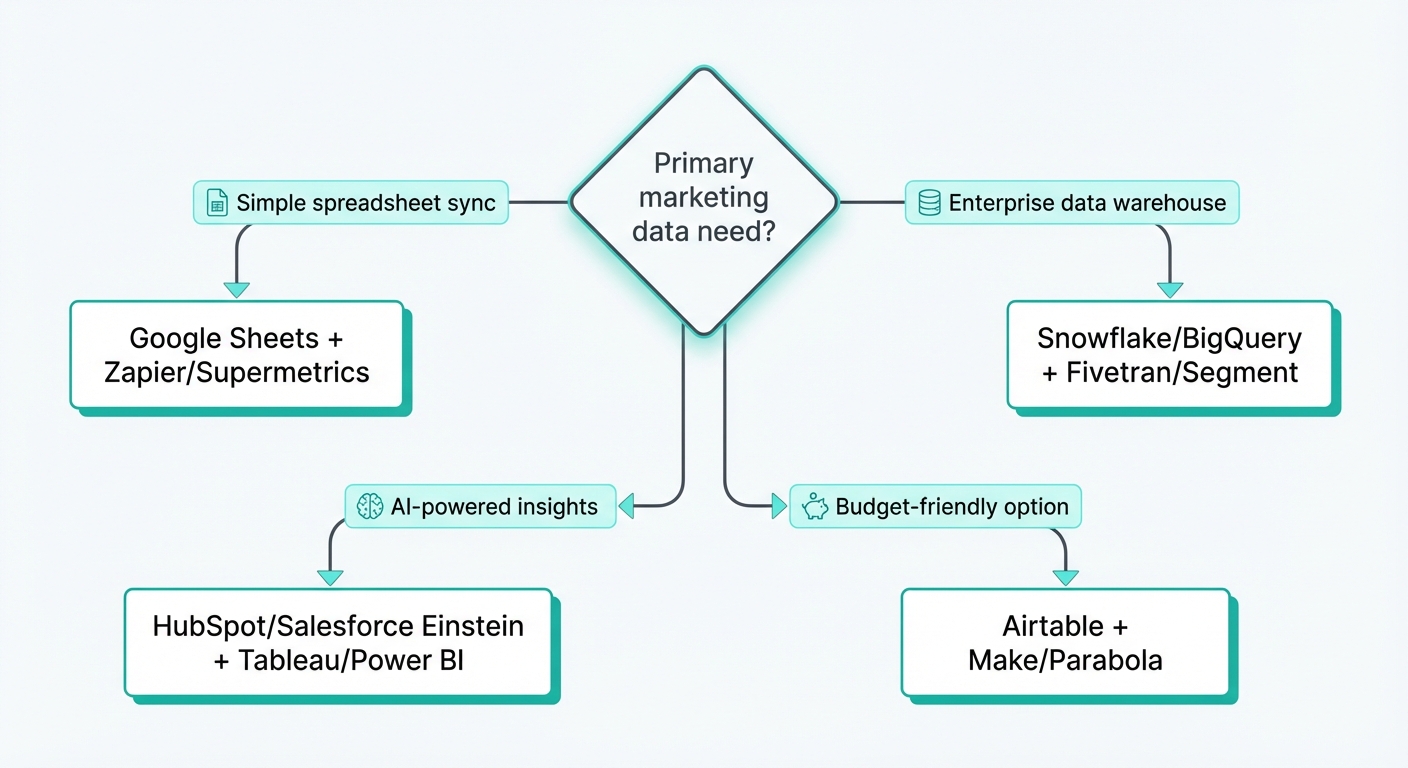 Decision tree for selecting marketing data tools
To find the right tool, answer these questions:
1. How technical is your team?
- Non-technical: MetricNexus, Coupler.io (use existing tools)
- Some SQL knowledge: Supermetrics, Stitch Data
- Data engineering team: Stitch Data, Improvado
2. Where does your marketing data live?
- Mostly in Google Sheets: Coupler.io, Supermetrics
- In a BI tool (Looker/Tableau): Supermetrics, Stitch Data
- In a data warehouse: Stitch Data
- Across 20+ channels: Supermetrics, MetricNexus
3. What's your primary goal?
- See ROI by channel: Windsor.ai, MetricNexus
- Build custom dashboards: Supermetrics, Funnel.io (stay)
- Advanced data transformation: Funnel.io (stay) or Stitch Data + dbt
- White-label for clients: Improvado
4. What's your budget constraint?
- Under $100/month: Windsor.ai, Coupler.io, Supermetrics Lite
- $100-300/month: MetricNexus, Supermetrics Standard, Stitch Data base
- $300+/month: Adverity, Improvado, Funnel.io Pro
Quick decision tree:
Code block (markdown)START: "Is Funnel.io affordable?"
├─ YES → Stay with Funnel.io (this article isn't for you)
└─ NO → Continue...
   ├─ "Do you live in Google Sheets?"
   │  ├─ YES → Coupler.io or Supermetrics
   │  └─ NO → Continue...
   ├─ "Do you need multi-touch attribution?"
   │  ├─ YES → Windsor.ai or MetricNexus
   │  └─ NO → Continue...
   ├─ "Do you have a data warehouse?"
   │  ├─ YES → Stitch Data
   │  └─ NO → MetricNexus or Supermetrics
How to Migrate from Funnel.io
If you decide to switch, here's the practical process:
Phase 1: Preparation (Week 1)
- Document all current dashboards in Funnel.io (screenshot or export)
- List every data transformation rule you've created
- Export historical data you need to preserve
- Note any custom fields or calculations
Phase 2: Parallel Run (Week 2-3)
- Set up your new tool alongside Funnel.io (don't disconnect yet)
- Connect the same data sources to both tools
- Build equivalent dashboards in the new platform
- Validate data matches between old and new systems
Phase 3: Cutover (Week 4)
- Stop making changes in Funnel.io
- Switch your stakeholders to the new dashboard
- Run both tools for 2 weeks to catch any discrepancies
- Cancel Funnel.io subscription
Phase 4: Optimization (Ongoing)
- Rebuild complex transformations in the new tool
- Train team on new interface and workflows
- Document new procedures for new team members
Key challenges to watch for:
- Historical data gaps: New tools may not have your full historical data. Plan for this upfront.
- Data definition differences: Funnel.io may calculate metrics slightly differently than your new tool. Investigate early.
- Field mapping: Custom fields you created in Funnel.io need to be recreated. Some tools make this easier than others.
- Team adoption: Your team is used to Funnel.io's interface. Budget time for training on the new tool.
Pro tip: Start with your lowest-stakes dashboards first. If you have an executive dashboard your CEO checks daily, keep that in Funnel.io until you're confident in the new tool. Move it last.
FAQ
Q: Is Funnel.io worth $400/month?
A: It depends on your data complexity. For enterprise marketing teams managing 50+ campaigns across 20+ channels with complex attribution needs, yes. For a 5-person agency running straightforward campaigns, probably not. If you're spending less than $10,000/month on ads, the data transformation value probably doesn't justify the cost.
Q: What's the cheapest Funnel.io alternative?
A: Windsor.ai at $19/month if you only care about ROI by channel. Coupler.io's free tier if you live in Google Sheets. MetricNexus at $49/month if you want a complete platform without the Sheets dependency.
Q: Can I get Funnel.io's features for less?
A: Not all of them. Funnel.io's data transformation layer is genuinely sophisticated. But you can get 80% of the value for 20% of the cost using Supermetrics (for integrations) + a BI tool (Looker Studio) + some manual cleanup. It requires more manual work but costs $30-300/month instead of $400+.
Q: How does Funnel.io compare to Supermetrics?
A: Funnel.io is a complete platform; Supermetrics is a connector library. Funnel.io transforms data; Supermetrics pulls raw data. Supermetrics is cheaper; Funnel.io is more polished. If you want a single tool to own all your marketing data, pick Funnel.io. If you prefer flexibility and already use Google Sheets or Looker Studio, pick Supermetrics.
Q: Will I lose accuracy switching away from Funnel.io?
A: Possibly, but probably not significantly. All modern data integration tools pull from the same APIs. Funnel.io's advantage is standardization—they normalize different platforms' naming conventions. You can achieve similar accuracy with manual cleanup or a BI tool, just with more work.
Q: What if I'm an agency offering services to clients?
A: Improvado is white-label by design. MetricNexus is building agency-friendly features. Supermetrics + Looker Studio is a solid foundation. Stitch Data + Tableau requires more build work but is more flexible. Funnel.io works if your clients can afford the cost.
Q: Can I use multiple tools at once?
A: Absolutely. Many teams use Supermetrics for basic data pulling and MetricNexus for AI-powered insights. Use Coupler.io for client-facing Sheets dashboards and Stitch Data for internal warehouse analytics. There's no rule against mixing and matching.
Q: How long does migration typically take?
A: Simple setup (2-3 channels, basic dashboards): 1-2 weeks. Moderate complexity (10+ channels, custom transformations): 4-6 weeks. Complex enterprise setup (20+ channels, sophisticated attribution): 8-12 weeks. Most of the time is in recreating transformations and validating data accuracy.
Bottom Line
Funnel.io is an excellent platform for enterprise marketing teams with complex data needs and budgets to match. But it's expensive, and most small businesses are overpaying for capabilities they never use.
You have realistic alternatives:
- If you want simplicity and AI: MetricNexus ($49-99/month)
- If you live in Google Sheets: Coupler.io (free-$250/month) or Supermetrics ($29-239/month)
- If you need attribution: Windsor.ai ($19-149/month) or MetricNexus
- If you want maximum flexibility: Stitch Data ($100-900/month) + a BI tool
- If you're agency-focused: Improvado ($400+/month) or MetricNexus
The honest truth: if your primary goal is seeing which marketing channels drive revenue, you can answer that question with Windsor.ai for $19/month. If you need sophisticated data transformation and governance, you'll need to pay more—but Funnel.io's $400/month base price is still a fair cost for that capability.
Switch from Funnel.io if you can, not if you should. Evaluate based on your actual data complexity, not just price. The cheapest tool is worthless if it doesn't solve your problem. The expensive tool is worthless if you don't use its capabilities.
Most teams land in the middle: MetricNexus or Supermetrics, with optional tools layered on top for specific needs. That combination delivers 85% of Funnel.io's value at 10-15% of the cost.
Start by answering: "What's one marketing question I can't currently answer?" Use the tool that answers that question most easily. That's your baseline. Everything else is nice-to-have.
Related Posts

Supermetrics Alternatives: Best Options for Small Businesses (2026)
Looking for a Supermetrics alternative? We compare 8 marketing data tools with pricing, features, and recommendations for small businesses.

The Complete Guide to Marketing Data (For Non-Technical Teams)
Everything you need to know about marketing data - without the jargon. A practical guide for marketers who aren't data engineers.
Databox Alternatives for Small Business Analytics
Looking for Databox alternatives? Compare 7 KPI dashboard and analytics tools with pricing and features for small businesses.
Ready to see your marketing data?
Start your free trial today. See your data in 5 minutes.
Start Free Trial