Marketing Attribution Explained (Finally, in Plain English)
Marketing attribution doesn't have to be complicated. Here's what it means, why it matters, and how to actually use it - without a PhD in statistics.
MetricNexus Team
Here's the truth: Attribution doesn't have to be complicated. In fact, most of the time people make it complicated.
Attribution is just answering one question: "Which marketing activities led to this sale?" That's it. Everything else is just different ways of answering that question.
If you've felt confused by attribution models, wading through jargon, or watching your marketing spend without knowing if it's actually working—this article is for you. We're going to cut through all the noise and explain what attribution actually is, why it matters for your business, and what you should actually do about it.
What Is Marketing Attribution?
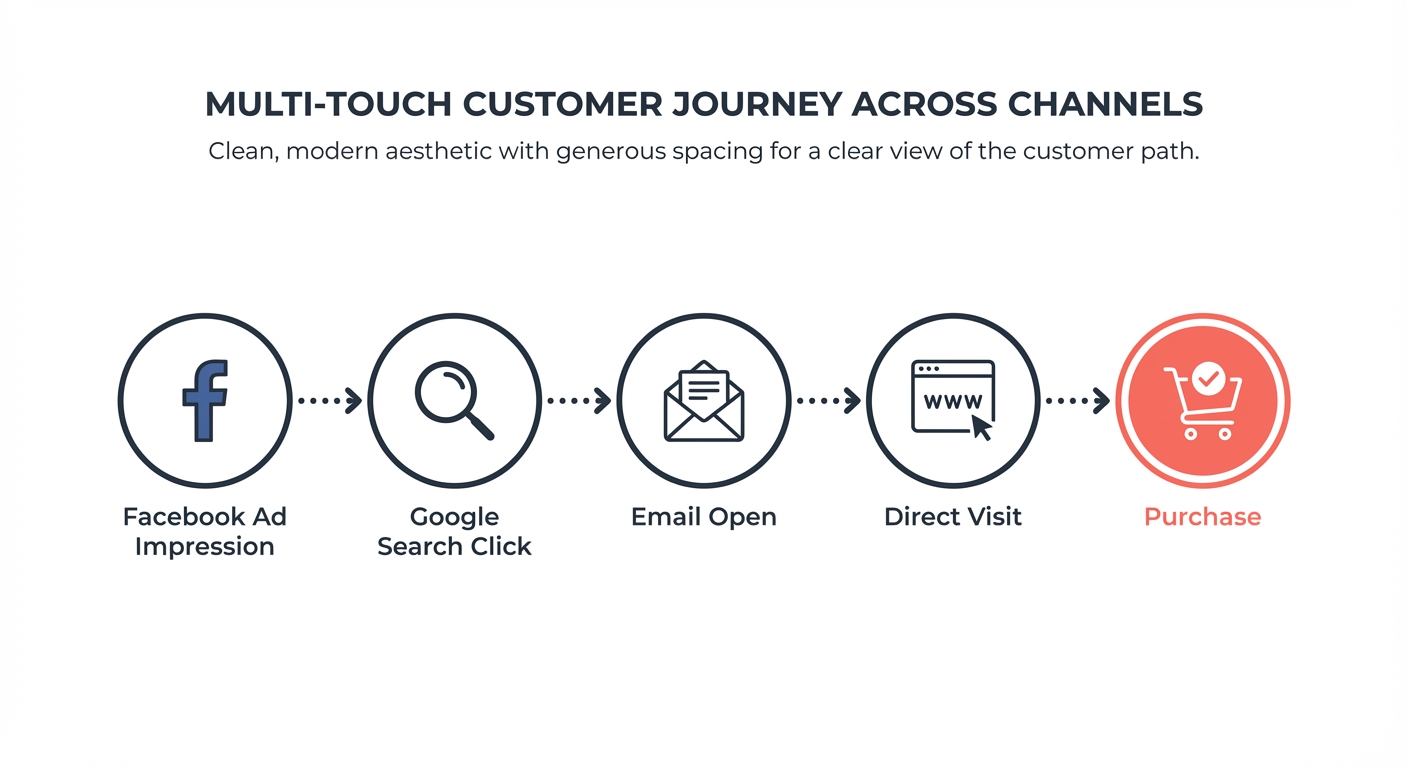 A multi-touch customer journey flowing from Facebook Ad to Google Search to Email to Direct Visit to Purchase
Let me tell you a real story.
Sarah owns a boutique e-commerce store selling sustainable home goods. One morning, she sees a Facebook ad for a competitor's product. She clicks it (actually, she clicks a competitor's ad by accident while scrolling). Nothing sticks.
That afternoon, she Googles "sustainable bamboo cutting boards" because she remembered wanting one. She clicks on Sarah's store in the search results. She browses for 10 minutes, adds something to her cart, then closes the browser. It's still on her mind.
Two days later, she's still thinking about that product. She clicks an email from Sarah's store about a weekend sale. She clicks through, completes her purchase for $89. Done.
So here's the question: Which of those touchpoints should get credit for the sale?
- The Facebook ad she saw (even though it was a competitor)?
- The Google search where she landed on Sarah's site?
- The email reminder about the sale?
That's attribution. It's literally asking: "How much credit does each marketing activity deserve for the sale that happened?"
And here's why this matters: if Sarah doesn't know which touchpoint deserves credit, she doesn't know where to spend her next marketing dollar. Should she spend more on Facebook? Google? Email? Or something else entirely?
The Attribution Problem (In Context)
The problem is that there's no single "correct" answer. Every customer's journey is different. Some people buy on the first click. Others need to see your brand five times before they trust you. Some people are price-conscious and respond to sale emails. Others saw you on social media three months ago and still think about it.
This is where attribution models come in. An attribution model is just a system for deciding how to distribute credit across all those touchpoints. Different models make different assumptions about what matters.
Why Attribution Matters for Small Businesses
Let's get practical. Why should you care about attribution?
The numbers are stark: companies without proper attribution models misallocate up to 30% of their marketing budget. That's not a rounding error--it's throwing nearly a third of your spend at channels that aren't working. And proper attribution reduces wasted ad spend by an average of 27%.
1. You're probably wasting money somewhere. Most small businesses run ads on multiple channels without actually knowing which ones drive revenue. They'll spend $500/month on Facebook and $500/month on Google, but have no idea that Facebook is generating $3 in revenue for every $1 spent, while Google is only returning $1 for every $1 spent. That's a problem.
2. You need to know what actually works. Attribution shows you which channels and campaigns are actually contributing to sales, not just clicks or impressions. A campaign can look "successful" on vanity metrics but contribute almost nothing to actual revenue.
3. You can prove marketing ROI. If you're spending money on marketing, you need to justify it—to your business partner, to investors, or just to yourself. Attribution lets you say "this Google Ads campaign generated $15,000 in revenue for a $2,000 spend." That's concrete.
4. You can double down on what works. Once you know which channels and campaigns are actually working, you can invest more in them. Maybe your email campaigns have a crazy high return rate. Perfect—automate them and scale them. Maybe your TikTok ads aren't converting. Stop throwing money at them.
5. You make smarter decisions. With attribution data, you're not guessing anymore. You're deciding based on real evidence about what's driving revenue.
For a small business with limited marketing budget, this is the difference between growing or stagnating.
Attribution Models Explained
Okay, let's talk about the different ways people calculate attribution. I'll be honest: most of them are just different opinions about what should matter.
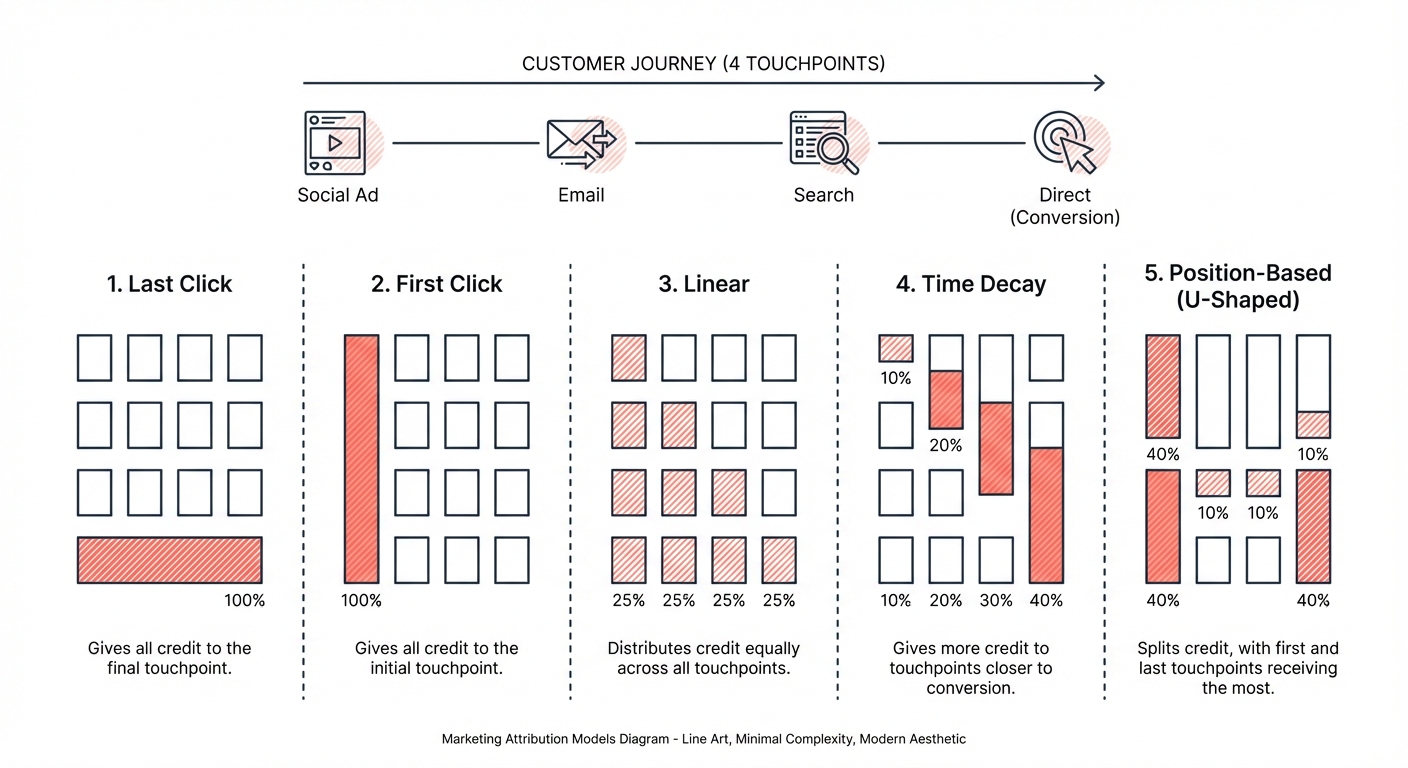 How five attribution models distribute credit across the same customer journey
Here's a quick-reference table before we dive deep:
| Model | Credit Distribution | Best For | Complexity |
|---|---|---|---|
| Last-Click | 100% to final touchpoint | Short funnels, direct response | Low |
| First-Click | 100% to first touchpoint | Brand awareness campaigns | Low |
| Linear | Equal across all touchpoints | Long sales cycles, B2B | Low |
| Time-Decay | More to recent, less to early | Considered purchases, B2B | Medium |
| Position-Based (U-Shaped) | 40% first, 40% last, 20% middle | Most businesses (good default) | Medium |
| W-Shaped | 30% first, 30% lead creation, 30% opportunity, 10% rest | B2B with sales pipeline | Medium |
| Data-Driven | ML-determined based on your data | High-volume advertisers (1000+ conversions/mo) | High |
Last-Click Attribution
What it is: 100% of the credit goes to the last thing the customer interacted with before buying.
Using Sarah's story: the email about the sale gets 100% of the credit. The Facebook ad and Google search get zero.
Pros:
- Dead simple to understand and implement
- Works well for direct-response campaigns (when you just want the immediate sale)
- Easy to track in most platforms
Cons:
- Completely ignores everything that led to that final click
- Undervalues awareness and education activities (like social media or content)
- Can make early marketing activities look worthless when they're actually crucial for building awareness
Best for: Businesses with short, simple sales funnels (usually just "see ad → buy immediately"). Also good for direct response campaigns where the last touchpoint is truly where the conversion happens.
When it fails: If your customer journey is more than one step, last-click attribution will mislead you. It'll make early-stage awareness activities look worthless.
First-Click Attribution
What it is: 100% of the credit goes to the first touchpoint in the customer's journey.
Using Sarah's story: the Facebook ad gets 100% of the credit, even though she didn't buy for days and almost didn't remember it.
Pros:
- Values discovery and first awareness
- Good for understanding which channels bring in new potential customers
- Useful for brand-building campaigns
Cons:
- Completely ignores everything that leads to conversion
- The first touchpoint may have just been random or lucky
- Overvalues top-of-funnel activities while ignoring bottom-of-funnel conversions
Best for: Businesses focused on brand awareness and discovery. Also useful for understanding which channels are most effective at reaching new audiences.
When it fails: If you care about actual revenue (not just awareness), first-click attribution is useless. It'll convince you that channels that bring awareness but not conversions are your best performers.
Linear Attribution
What it is: All touchpoints get equal credit.
Using Sarah's story: the Facebook ad, Google search, and email each get 33% of the credit.
Pros:
- Acknowledges that the entire customer journey matters
- No single touchpoint is arbitrarily privileged over others
- Works well if all touchpoints are truly equally important
Cons:
- Assumes all touchpoints are equally important (they're usually not)
- Doesn't differentiate between awareness-stage and conversion-stage activities
- Can obscure which parts of your funnel actually drive sales
Best for: Long sales cycles where many touchpoints genuinely matter equally (some B2B scenarios).
When it fails: Most of the time. In most customer journeys, different touchpoints matter at different stages. The Google search that reminded Sarah about the product probably mattered more than the random Facebook ad. Linear attribution doesn't capture that nuance.
Time-Decay Attribution
What it is: More recent touchpoints get more credit. Earlier touchpoints get less credit.
Using Sarah's story: the email gets the most credit (it was most recent), the Google search gets some credit, the Facebook ad gets very little.
Pros:
- Values the conversion-driving touchpoint without completely ignoring awareness
- Recognizes that recent interactions are usually more relevant to a purchase decision
- Balances the full customer journey with the reality of how sales happen
Cons:
- Slightly more complex to calculate
- The "decay rate" (how much older touchpoints matter) is arbitrary
- Can still undervalue early awareness activities
Best for: B2B sales, considered purchases, and longer decision cycles. Really anywhere the final touchpoint is more important than the first one, but both matter.
When it fails: With very short sales cycles (like impulse purchases), where all the decay complexity is overkill.
Position-Based (U-Shaped) Attribution
What it is: The first and last touchpoints each get 40% of the credit. Everything in the middle splits the remaining 20%.
Using Sarah's story: the Facebook ad gets 40%, the email gets 40%, and the Google search gets 20%.
Pros:
- Balances discovery and conversion
- Recognizes that both the first touchpoint (discovery) and last touchpoint (conversion) matter
- Not overly complex, but more sophisticated than linear or last-click
- Works well for most types of businesses
Cons:
- The 40-40-20 split is somewhat arbitrary
- If you have many middle touchpoints, they each get very little credit
- Doesn't account for varying sales cycle lengths
Best for: Most businesses. If you're not sure which model to use, this is a solid default. It values both the initial awareness and the final conversion-driving interaction.
When it fails: Very complex journeys with many meaningful touchpoints in the middle. Also not ideal if your sales cycle is extremely short or extremely long.
W-Shaped Attribution
What it is: 30% of credit goes to three key moments: the first touch, the lead creation touch, and the opportunity creation touch. The remaining 10% is split across everything else.
This model is popular in B2B, where there's a clear handoff between marketing and sales. It recognizes that three moments really matter: how a prospect found you, what made them become a lead, and what moved them into the sales pipeline.
Pros:
- Credits both marketing and sales contributions
- Identifies which touchpoints create pipeline, not just awareness
- Works well for businesses with defined lead qualification stages
Cons:
- Requires clear lead-creation and opportunity-creation events in your CRM
- Overkill for most small B2C businesses
- The 30-30-30-10 split is still somewhat arbitrary
Best for: B2B businesses with a defined sales pipeline and CRM tracking. If you have a clear "marketing qualified lead" stage, W-shaped attribution can tell you what's driving pipeline, not just traffic.
When it fails: Simple e-commerce or short-cycle businesses. If your funnel doesn't have distinct lead-creation and opportunity-creation stages, the W-shape has nothing meaningful to measure.
Data-Driven Attribution
What it is: Machine learning analyzes all your conversion data and figures out how much credit each touchpoint should get based on statistical patterns.
Pros:
- Theoretically the most accurate (it's based on what actually happened in your data)
- Adapts to your specific business and customer behavior
- Gets more accurate as you collect more data
- Google now uses this by default in Google Ads
Cons:
- It's a black box (you can't see exactly why it made certain decisions)
- Requires a decent amount of data to work well (at least thousands of conversions)
- Can be overfit (optimizing to your specific data, which may not predict future behavior)
- Only as good as your data (garbage in, garbage out)
Best for: Large advertisers with high conversion volumes. Once you're spending thousands of dollars per month and have thousands of conversions per month, this model is worth investigating.
When it fails: Small businesses with low conversion volumes. Data-driven models need lots of data to work properly. If you're getting 50 conversions per month, you don't have enough data for ML to find meaningful patterns.
Which Attribution Model Should You Use?
Here's the practical answer: it depends on your situation.
If you're a small business with a simple funnel and a small budget (under $5K/month): Use last-click attribution. Seriously. Don't overthink it. You probably have few enough customers and a simple enough sales process that last-click will give you directional truth. And the simplicity means you'll actually use the data.
If you're spending $5K-20K per month across multiple channels: Use position-based (40-40-20) attribution. It's sophisticated enough to handle multi-channel journeys but not so complex that you'll never actually implement it. It values both discovery and conversion, which matters in most real-world scenarios.
If you're doing brand awareness and top-of-funnel marketing: Use first-click attribution for that campaign specifically. You're trying to understand which channels bring in new potential customers, not which channels drive conversions.
If you have a complex sales cycle (especially B2B) with many meaningful touchpoints: Use time-decay attribution. You need to recognize that multiple touchpoints matter, but that the final interactions are most relevant to the sale.
If you're spending $20K+ per month with thousands of conversions: Use data-driven attribution (if available in your platform). You have enough data for ML to find real patterns. But even then, check that the results make intuitive sense. If Google tells you that display impressions (the ones that barely anyone clicks) are 40% of your conversions, that should raise a red flag.
The most important thing: Pick one model and stick with it for at least 3-6 months. The goal isn't to find the perfect model (it doesn't exist). The goal is to get directional understanding of which channels drive revenue. One decent model applied consistently will get you there.
The Real Problem: Attribution Is Broken
Before we go further, I need to be honest with you: attribution is fundamentally imperfect. Not because the math is wrong, but because the real world is messy.
iOS tracking limitations: In 2021, Apple made a change called App Tracking Transparency (ATT). Basically, it made it much harder for apps to track users. That meant Facebook and Instagram couldn't see what happened after users clicked ads in iOS browsers. This broke a lot of attribution pipelines overnight.
Third-party cookies are dying: For years, marketers have relied on third-party cookies to track users across websites. Google and other browsers are phasing these out. By 2026, most browsers will have disabled third-party cookies. This is going to break attribution for a lot of businesses.
Users are on multiple devices: Sarah researched on her phone, maybe browsed on a laptop at work, and checked out on her tablet at home. But her phone, laptop, and tablet show up as three different people in many tracking systems. Attribution models can't see that it's the same person.
Walled gardens: Facebook doesn't see what happens after you click a Facebook ad and visit Google. Google doesn't see what happens before you search on Google. Each platform only sees its own data. So when they report conversions, they're both right within their data, but they're also both overcounting. Here's a real-world example: a business might see Facebook reporting 250 conversions, Google reporting 280, but only 300 actual conversions in their CRM. Both platforms are claiming overlapping credit.
Impressions that don't get clicked still matter. For every ad click, there are 10 to 50 impressions that don't result in a click but still shape buying decisions. Most attribution models only track clicks, which means they systematically undervalue display and video ads that build awareness without generating clicks.
Users block tracking: Many people use ad blockers, privacy-focused browsers, or explicitly don't allow tracking. Those conversions are invisible to attribution systems.
Unattributed conversions: Tons of people find you through word-of-mouth, direct traffic, or just remembering your URL. These show up as "direct" traffic, and it's impossible to know where they actually came from.
Hidden attribution biases. Beyond the obvious limitations, attribution models carry built-in biases you should know about:
- Correlation bias: A customer who clicks 5 ads before buying isn't necessarily influenced by all 5. Some clicks happen because they were already going to buy.
- Cheap inventory bias: Low-cost ad placements (like bottom-of-page display ads) can appear to perform well on a cost-per-conversion basis, but they may have had zero influence on the purchase decision.
- Digital signal bias: Online touchpoints are easy to track. Offline touchpoints (word-of-mouth, in-store, podcast mentions) are invisible. Attribution over-credits digital channels by default because that's all it can see.
The bottom line: Attribution is always a guess. It's an educated guess based on the data you can see. But it's never complete. Every attribution model is basically saying "given what we can measure, here's our best guess about what happened." Keep that humility. Attribution can guide your decisions, but it can't make them for you.
Practical Attribution for Small Businesses
Okay, so attribution is imperfect. What do you actually do about it?
1. Use Platform Attribution (Carefully)
Google Ads and Meta (Facebook/Instagram) both report conversions. They'll tell you "this ad campaign generated 47 conversions with a ROAS of 3.2:1." These numbers are useful.
But they're also overcounting. Both Google and Meta want to show strong results. There's an incentive to attribute conversions to their platform even when multiple platforms deserve credit. Research suggests both platforms overclaim attribution by 20-50% depending on your funnel.
So use platform attribution as directional data. If Google Ads says a campaign is returning 4:1 ROAS and Meta says it's returning 1.5:1 ROAS, that's meaningful. Google Ads is probably performing better. You can act on that.
But don't take the exact numbers as gospel. Treat them as ranges. If Google says 4:1, the real return is probably between 3:1 and 4:1. Still good, just not exactly 4.
2. Ask Your Customers
This is low-tech, but it works. After someone buys, ask them: "How did you hear about us?"
You can do this:
- In a post-purchase email
- In a survey (offer a $5 discount for completion)
- In a follow-up call (for higher-ticket items)
This gives you real data from your customers about what actually influenced them. It won't be perfect (people forget things), but it'll be honest. And it won't be distorted by platform incentives.
Sarah, in our example, would probably answer: "I saw a Facebook ad, then I Googled you, then I got your email." That's more informative than any platform's attribution model.
3. Track the Right Metrics
Instead of obsessing over per-channel attribution, track these overall metrics:
Customer Acquisition Cost (CAC): Total marketing spend divided by number of new customers. If you spent $10,000 and got 100 new customers, your CAC is $100.
Return on Ad Spend (ROAS): Revenue from ads divided by ad spend. If you spent $2,000 on ads and got $6,000 in revenue, your ROAS is 3:1.
Customer Lifetime Value (LTV): How much a typical customer spends with you over their lifetime.
The most useful metric is LTV:CAC ratio. If your CAC is $100 and LTV is $1,000, you're making money. If your CAC is $100 and LTV is $80, you're losing money.
For context, here are average conversion rates by channel to help you benchmark:
| Channel | Avg. Conversion Rate |
|---|---|
| Organic Search | 5.0% |
| Referral | 4.1% |
| Email Marketing | 3.9% |
| Paid Search | 3.6% |
| Social Media | 1.9% |
Don't optimize for attribution accuracy. Optimize for LTV:CAC ratio. That's what actually matters.
4. Run Incrementality Tests
This is the most reliable way to know if your marketing actually works.
Pick one channel (or one campaign) and turn it off. Measure what happens to overall sales. That's the true impact of that channel.
Example: You spend $5,000/month on Facebook ads. Your total revenue is $20,000/month. Turn off Facebook ads for one week. Your revenue drops to $17,000. That's your true incrementality. Facebook actually drove that revenue, not some other channel taking credit for it.
If turning off a channel entirely feels too risky, try a geographic holdout test: run ads in some regions but not others, then compare conversion rates. Meta and Google both offer built-in conversion lift study tools that automate this.
This is harder than reading an attribution report, but it's the closest thing to truth you'll get.
First-Party Data and Future-Proofing
Here's what's changing in marketing: we're moving from a world where platforms track everything, to a world where businesses track their own customers (first-party data).
This is actually good news for you. It means you're less dependent on Google and Meta's broken attribution systems. It also means you have more control.
Server-side tracking: Instead of tracking through cookies or app events, you send tracking data directly from your server. This is more reliable, less affected by ad blockers, and better for privacy.
Conversion APIs: Meta and Google both offer conversion APIs where you send conversion data directly from your server instead of relying on pixel-based tracking. This works even when third-party cookies are gone.
First-party data collection: Ask for email addresses, phone numbers, or other first-party identifiers. Use them to recognize customers across devices and sessions.
What you should do:
- Set up the Conversion API for Meta and Google (both are free)
- Start collecting first-party identifiers (email, phone, CRM ID)
- Think about what customer data you own vs. what you're borrowing from platforms
- Consider tools like Segment or custom CDP solutions if you have complex tracking needs
Marketing Mix Modeling (MMM) as a complement: If you're spending heavily, consider combining attribution with marketing mix modeling. MMM uses statistical regression on aggregate data (total spend, total conversions, seasonality) to estimate each channel's impact without relying on user-level tracking at all. It's the opposite approach to attribution--top-down instead of bottom-up. Some advanced teams use both: attribution for tactical, day-to-day optimization and MMM for strategic budget allocation. For most small businesses, this is overkill, but it's worth knowing about as your spend grows.
None of this is required right now. But it's coming. Start building these foundations now, and you'll be ahead when third-party cookies fully disappear.
Common Attribution Mistakes
Here are mistakes I see small businesses make all the time:
Mistake 1: Obsessing over perfect attribution. Perfect attribution doesn't exist. Stop looking for it. Use a model that's "good enough" and move on. The difference between a perfect model and a good-enough model is probably only 5-10% accuracy difference, but the time investment is 10x. Not worth it.
Mistake 2: Trusting platform reporting blindly. If Google and Meta both show strong returns for their platforms (and different returns from each other), you're getting overcounting from at least one of them. Use it as directional data, not absolute truth.
Mistake 3: Not accounting for view-through conversions. People see your ad (but don't click it) and then buy later. That conversion should be attributed to the ad, but many attribution systems don't track this. Check your platform settings to make sure view-through conversions are included.
Mistake 4: Changing attribution models constantly. "Last month we used last-click, this month let's try time-decay." Nope. Pick a model and stick with it for at least a quarter. You need consistency to see patterns.
Mistake 5: Forgetting that correlation isn't causation. Just because sales went up the same month you started a new campaign doesn't mean the campaign caused the increase. You need to isolate the impact (incrementality tests are the way to do this).
Mistake 6: Only looking at direct performance metrics. Focus on overall CAC and LTV, not just per-channel metrics. A channel might look bad on attribution but be valuable for brand building, which drives overall demand.
Attribution Tools and Setup
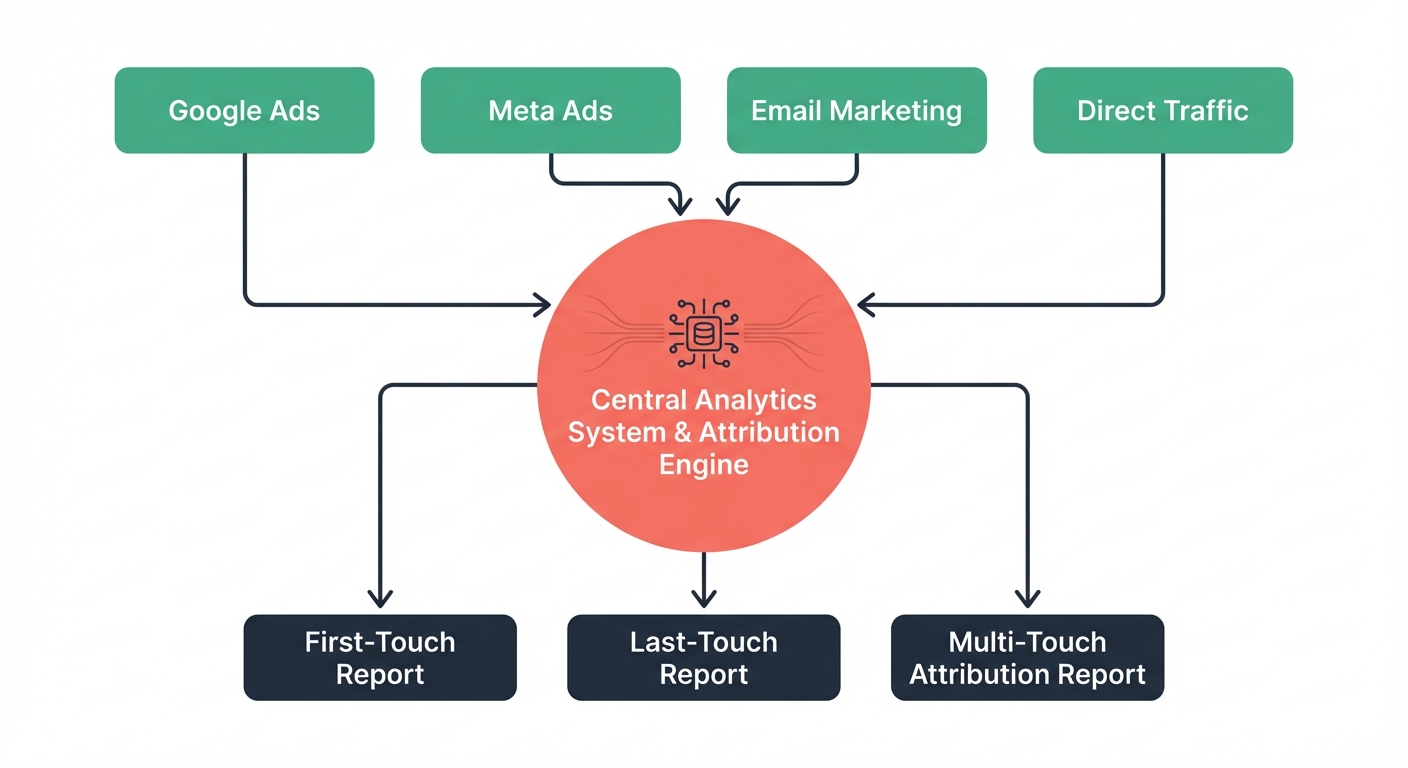 How attribution data flows from marketing platforms into a central analytics engine
You probably have access to attribution data already. Here's how to actually use it:
Google Ads
Google uses data-driven attribution by default these days. To check your attribution model:
- Go to Tools → Conversions
- Click on your conversion action
- Check the "Attribution model" setting
- Check attribution reports under Insights → Conversion paths
You can compare different models side-by-side to see how they change the numbers. But again, don't overthink it. If data-driven attribution seems reasonable, use it.
Meta (Facebook)
Meta also uses a default attribution model. To check it:
- Go to Ads Manager → Conversions
- Check your conversion settings
- Look at the "attribution window" (the time frame in which conversions are attributed)
- Compare 1-day and 7-day attribution windows to see how much it matters
If you have iOS-app users, set up the Conversions API to ensure their conversions are tracked properly even with iOS limitations.
Google Analytics 4
Important update: In late 2023, Google removed first-click, linear, time-decay, and position-based attribution models from GA4. You now have two options: data-driven attribution (the default) and last-click. This is a significant change--if you were relying on position-based or time-decay models in GA4, you'll need to either use data-driven or move to a third-party tool.
To configure GA4 attribution:
- Go to Admin → Data display → Attribution settings
- Choose your attribution model (data-driven is the default and recommended)
- Go to Advertising → Attribution → Conversion paths to see multi-touch journey data
- Note: GA4 has a maximum attribution window of 90 days
The "Conversion paths" report is incredibly useful. It shows the actual sequences of channels that led to conversions. This is real data from your customers.
One thing to watch: GA4 user-scoped and session-scoped dimensions always use last non-direct click attribution regardless of your settings. Only event-scoped dimensions use your chosen model. This catches a lot of people off guard.
Third-Party Tools (When You Need Them)
If you're spending heavily on multiple channels and need sophisticated attribution, here are the main categories:
Multi-touch attribution platforms:
- Ruler Analytics - Multi-touch attribution built for SMBs, connects ad spend to revenue
- Northbeam - Data-driven attribution for e-commerce (strong DTC focus)
- Triple Whale - Attribution and analytics for Shopify stores
- Wicked Reports - Multi-touch attribution with CRM integration
Data infrastructure + attribution:
- Improvado - Marketing data warehouse with attribution reporting
- Segment - Customer data platform that feeds attribution models
- Amplitude - Product analytics with built-in attribution (uses Markov chain models)
Mobile attribution:
- AppsFlyer - Mobile measurement partner for app install attribution
- Adjust - Mobile attribution and analytics
But be honest: most small businesses don't need these. Platform attribution + customer surveys + tracking CAC/LTV will get you 90% of the way there. Save third-party tools for when you're spending $50K+ per month and need that extra 10%.
FAQ
What is marketing attribution? Marketing attribution is the process of assigning credit to marketing touchpoints for a conversion. When a customer interacts with multiple ads or channels before buying, attribution decides which ones deserve credit for the sale.
Which attribution model is best? There's no "best"—it depends on your business. Position-based (40-40-20) is a good default for most businesses. Last-click works for simple funnels. First-click works for awareness campaigns. Pick one and stick with it for consistency.
How do I track marketing attribution? Most platforms (Google Ads, Meta, GA4) have built-in attribution. Set up the Conversions API for Meta and Google to improve tracking accuracy. Ask customers post-purchase how they heard about you. Calculate overall CAC and LTV. That covers 90% of what you need.
Is last-click attribution still useful? Yes, for simple, short-funnel businesses. If your customer journey is "see ad → buy immediately," last-click tells you what you need to know. It's only useless if your sales cycle is longer or more complex.
Why do Google and Meta report different numbers? They're measuring from their perspective using different models and lookback windows. Both are technically right about what they can see, but they're both overestimating their contribution. Treat them as directional, not absolute.
What should I do about iOS tracking limitations? Set up the Conversions API so you can track conversions server-side even when pixel-based tracking fails. Collect first-party data like email addresses so you're not fully dependent on platform tracking.
Do I really need a third-party attribution tool? Probably not, unless you're spending $50K+ per month and need sophisticated multi-touch attribution. Platform tools + customer surveys get you 90% of the way.
What happened to attribution models in GA4? Google removed first-click, linear, time-decay, and position-based models from GA4 in October 2023. You now have two options: data-driven attribution (the default) and last-click. If you need the removed models, you'll need a third-party tool.
What's the difference between attribution and marketing mix modeling? Attribution tracks individual user journeys bottom-up (which clicks led to this sale). Marketing mix modeling (MMM) uses aggregate data top-down (how does total spend correlate with total revenue). Attribution is better for tactical optimization. MMM is better for strategic budget allocation, especially for measuring offline channels that attribution can't track.
How many touchpoints does the average customer have before converting? It varies by industry, but research shows the average is 6-10 touchpoints for organic search alone. B2B journeys tend to be longer. This is why single-touch models (first-click, last-click) miss so much of the picture.
The Bottom Line
Attribution is confusing, but it doesn't have to be. Here's what you actually need to know:
-
Attribution is answering one question: "Which marketing activities led to this sale?" It's not more complicated than that. Everything else is just different opinions about how to answer it.
-
Perfect attribution doesn't exist. Tracking is broken by iOS limitations, cookie deprecation, multiple devices, and walled gardens. Every attribution model is an educated guess. Accept that and move on.
-
Use what works for your situation: Small budget? Last-click is fine. Multiple channels? Use position-based attribution. High volume? Try data-driven. But don't overthink it.
-
Directional data is valuable. You don't need perfect attribution to know that Google Ads is outperforming Facebook, or that email has a higher ROAS than social. Use attribution to identify directional trends, then test them.
-
Don't let attribution paralysis stop you. I've seen businesses spend months agonizing over the perfect attribution model instead of actually marketing. Ship something, measure it, improve it. Perfect data in three months is less valuable than good data now.
-
Focus on business metrics, not attribution metrics. CAC and LTV matter. Overall ROAS matters. Per-channel attribution accuracy? Much less important. Make sure your CAC is lower than your LTV, and you're winning.
-
Ask your customers. The most underrated source of attribution data is just asking people how they heard about you. Use post-purchase surveys. The data is honest, direct, and unmediated by platform incentives.
-
Test what matters. Run incrementality tests. Turn off a channel for a week and see what actually happens. That's the closest thing to truth.
Attribution is a tool for making smarter decisions. It shouldn't be so complex that you never actually use it. Pick a simple system that works for your business, measure consistently, and adjust based on real results. That's all you need.
Related Posts
The Complete Guide to Marketing Data (For Non-Technical Teams)
Everything you need to know about marketing data - without the jargon. A practical guide for marketers who aren't data engineers.

SMB Marketing Benchmarks 2026: What 'Good' Actually Looks Like
Marketing benchmarks specifically for small businesses. Real data on ROAS, CAC, conversion rates, and more - not enterprise metrics.

What's a Good ROAS? Benchmarks by Industry and Ad Spend
ROAS benchmarks by industry, ad platform, and budget size. Learn what 'good' really means for your business and how to improve it.
Ready to see your marketing data?
Start your free trial today. See your data in 5 minutes.
Start Free Trial